Introduction
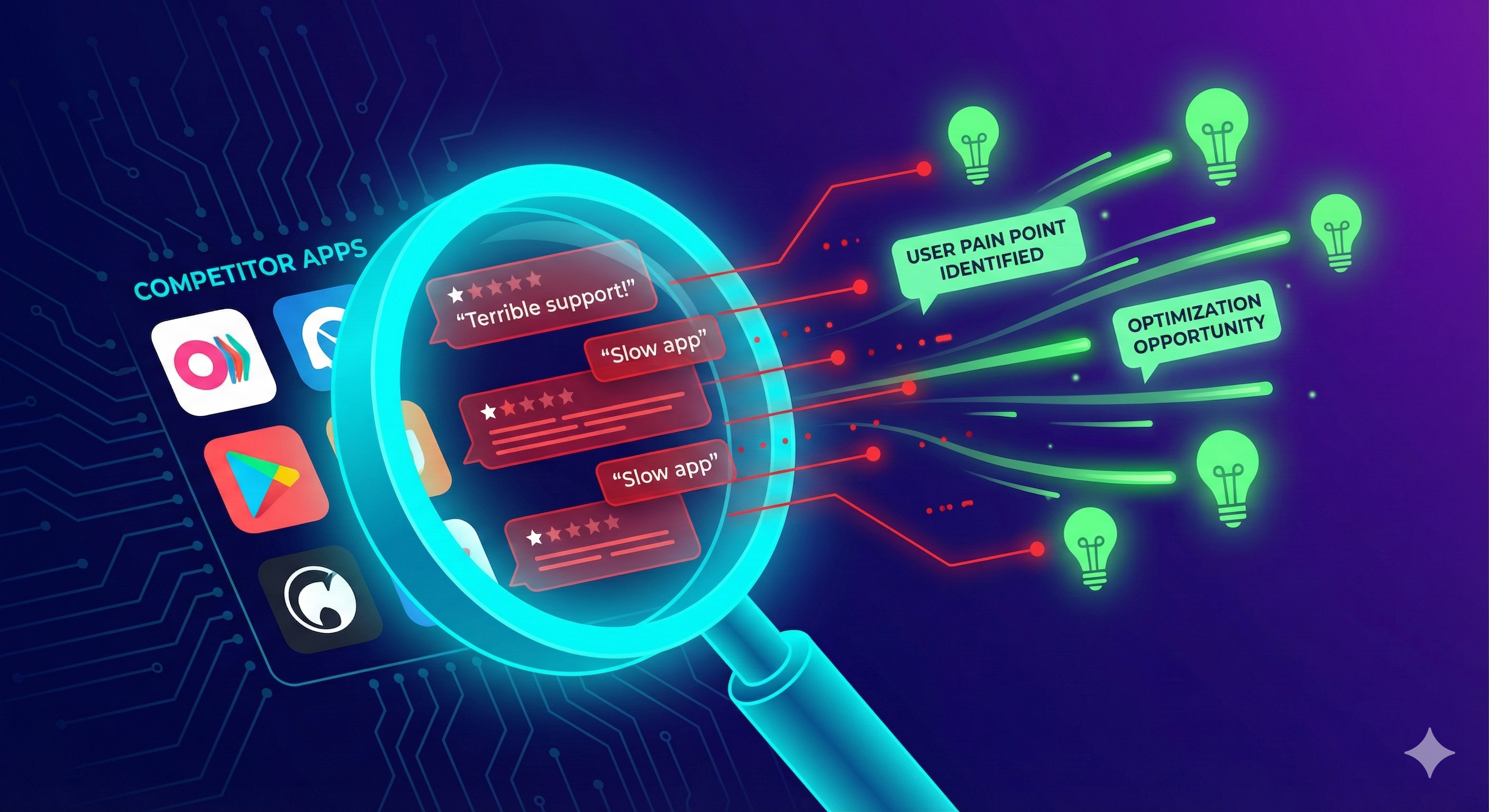
Every day, thousands of users publicly document exactly what they hate about your competitors' apps. They detail missing features, frustrating bugs, poor customer service, and unmet expectations—all in searchable, public reviews.
This is the most valuable competitive intelligence available, and it's completely free.
Yet most app developers never systematically analyze competitor reviews. They're leaving money on the table—opportunities to differentiate, position, and capture frustrated users who are actively looking for alternatives.
This guide shows you how to turn competitor reviews into actionable competitive advantages.
Why Competitor Reviews Are Gold
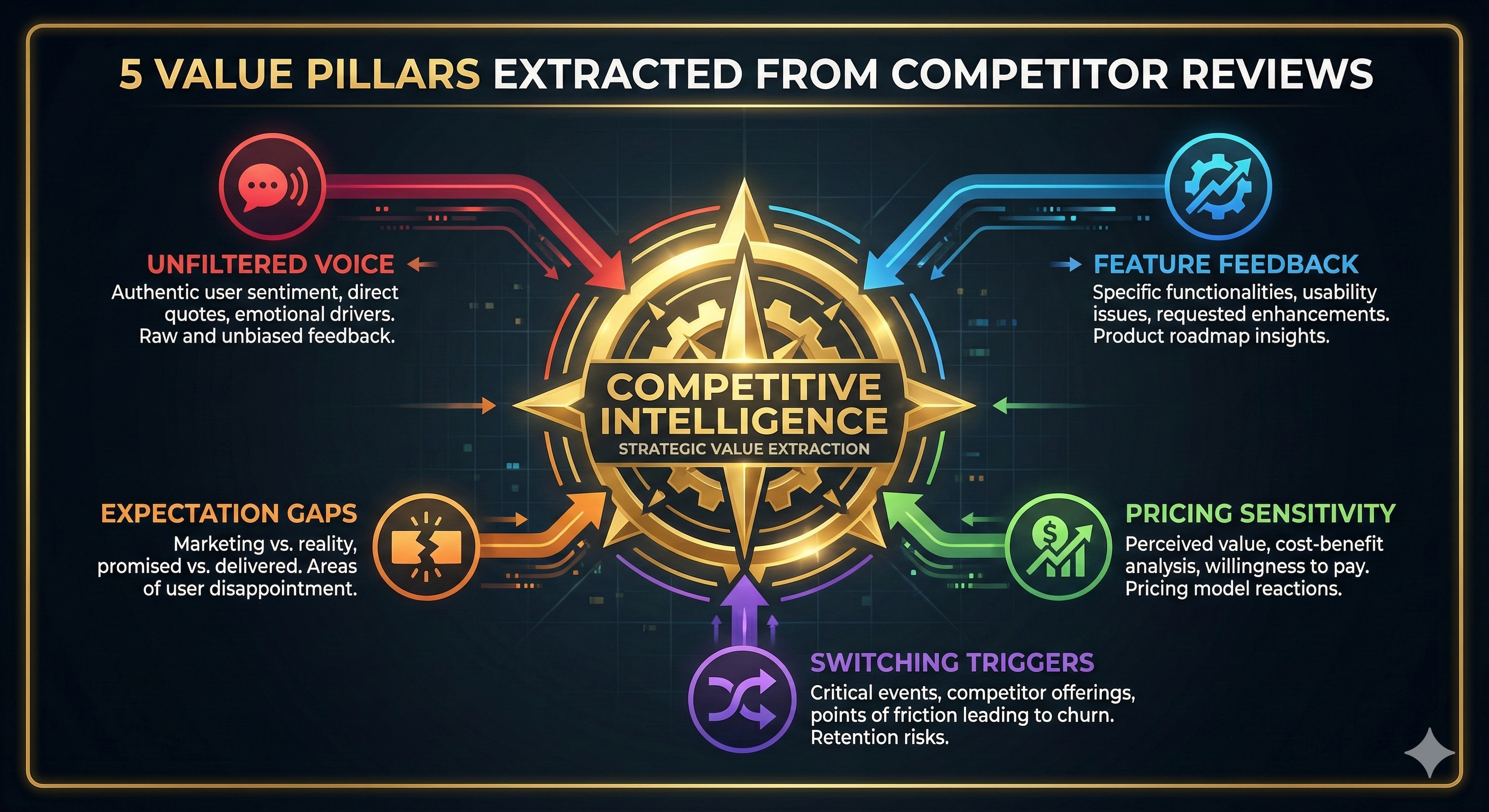
Competitor reviews offer unique insights you can't get anywhere else:
1. Unfiltered User Voice
Unlike surveys or focus groups, reviews capture genuine emotional reactions. Users write reviews when they're moved enough to take action—whether from delight or frustration.
2. Feature-Level Feedback
Reviews often mention specific features by name. You can identify exactly which features users love and which ones cause problems.
3. Expectation Gaps
When users complain, they often describe what they expected versus what they got. This reveals unmet market expectations you can address.
4. Pricing Sensitivity
Reviews frequently mention value perception. You can learn what price points feel fair and what triggers "not worth it" reactions.
5. Switching Triggers
Many negative reviews explicitly state intent to switch or recommend alternatives. These are your potential customers.
Setting Up Your Competitive Analysis
Step 1: Identify Your Competitors
Create three tiers of competitors:
Direct competitors: Apps that solve the same problem for the same audience
- Same category in app stores
- Similar feature sets
- Targeting the same user segments
Indirect competitors: Apps that solve the same problem differently
- Different approach to the same user need
- Adjacent categories
- Web or desktop alternatives
Aspirational competitors: Market leaders you want to learn from
- Best-in-class user experience
- Highest ratings in your space
- Models of what "good" looks like
Step 2: Gather Review Data
For each competitor, collect:
- Recent reviews (last 3-6 months)
- 1-star and 2-star reviews (pain points)
- 5-star reviews (what works)
- Reviews mentioning feature requests
- Reviews that mention your app or alternatives
Step 3: Create Analysis Categories
Organize findings into actionable categories:
- Bugs and reliability issues
- Missing features
- UX complaints
- Pricing objections
- Customer support issues
- Performance problems
- Praised features
Mining Competitor Weaknesses
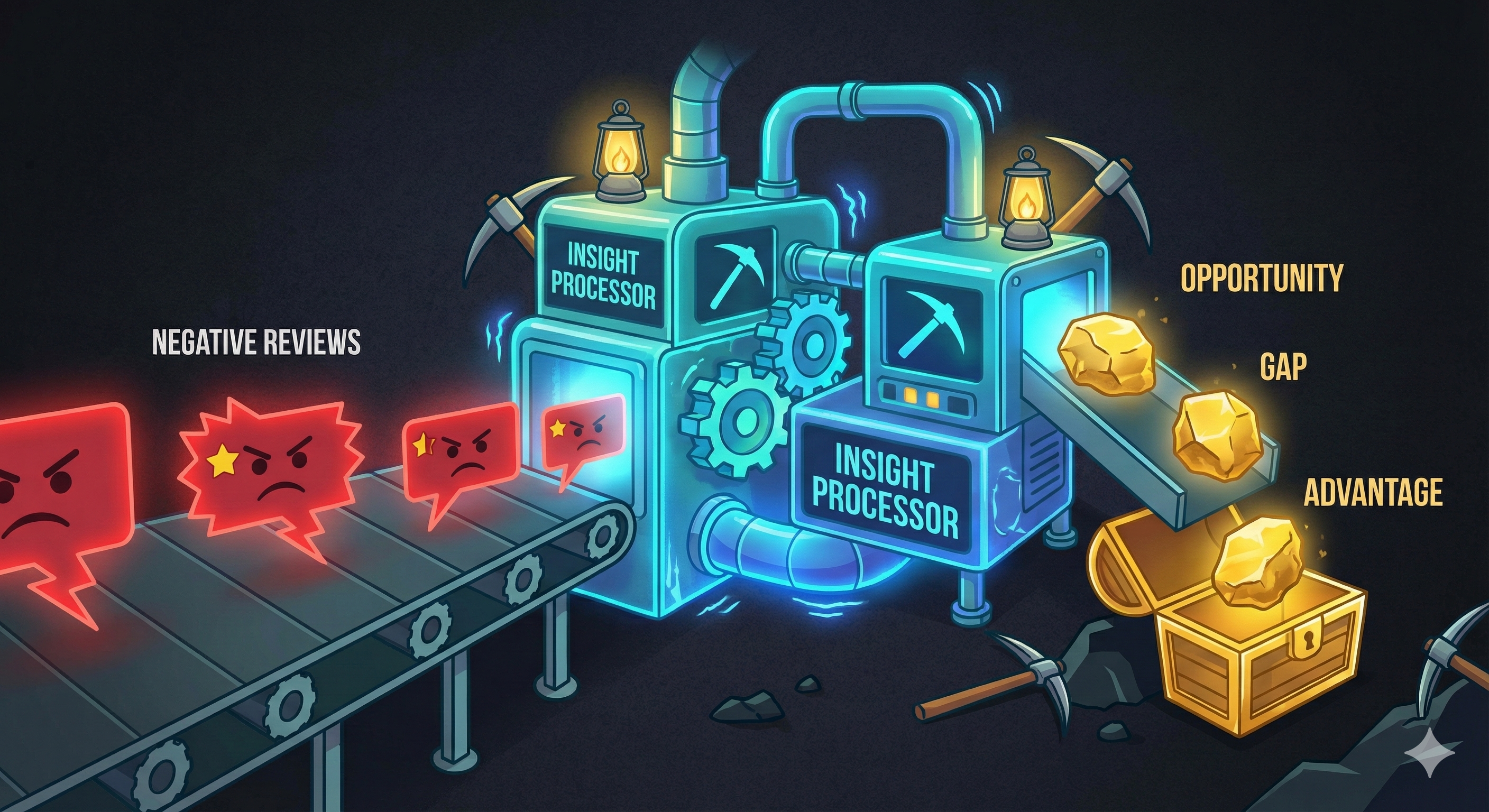
Negative reviews reveal opportunities. Here's how to systematically extract them:
Pattern 1: Recurring Complaints
Look for complaints that appear repeatedly. If 50 users mention the same issue, it's a systemic problem—and an opportunity for you.
Example analysis:
"Competitor X has 47 reviews mentioning 'sync issues' in the last 3 months. Their response is always the same generic message. Users are frustrated and seeking alternatives."
Your opportunity: Emphasize reliability and sync performance in your marketing. Highlight it as a differentiator.
Pattern 2: Recently Broken Features
Watch for review clusters after updates. Competitors sometimes break things, creating windows of opportunity.
Example analysis:
"After Competitor Y's v3.0 update, 200+ 1-star reviews appeared in 2 weeks complaining about the redesigned interface."
Your opportunity: Target their frustrated users with stability-focused messaging. "We don't change what works."
Pattern 3: Ignored Feature Requests
Users often request features that competitors never implement. These represent unmet market demand.
Example analysis:
"Dark mode has been requested in Competitor Z's reviews for 3+ years. They still haven't added it. 89 reviews explicitly mention this."
Your opportunity: If you have dark mode, make it prominent in your screenshots. If you don't, consider prioritizing it.
Pattern 4: Pricing Pain
Price complaints reveal value perception issues you can exploit.
Example analysis:
"Competitor A's subscription increase from $4.99 to $9.99/month generated 340 1-star reviews in one month. Users feel trapped because they have data in the app."
Your opportunity: Offer competitive pricing, easy data import, or a transparent pricing promise.
Learning from Competitor Strengths
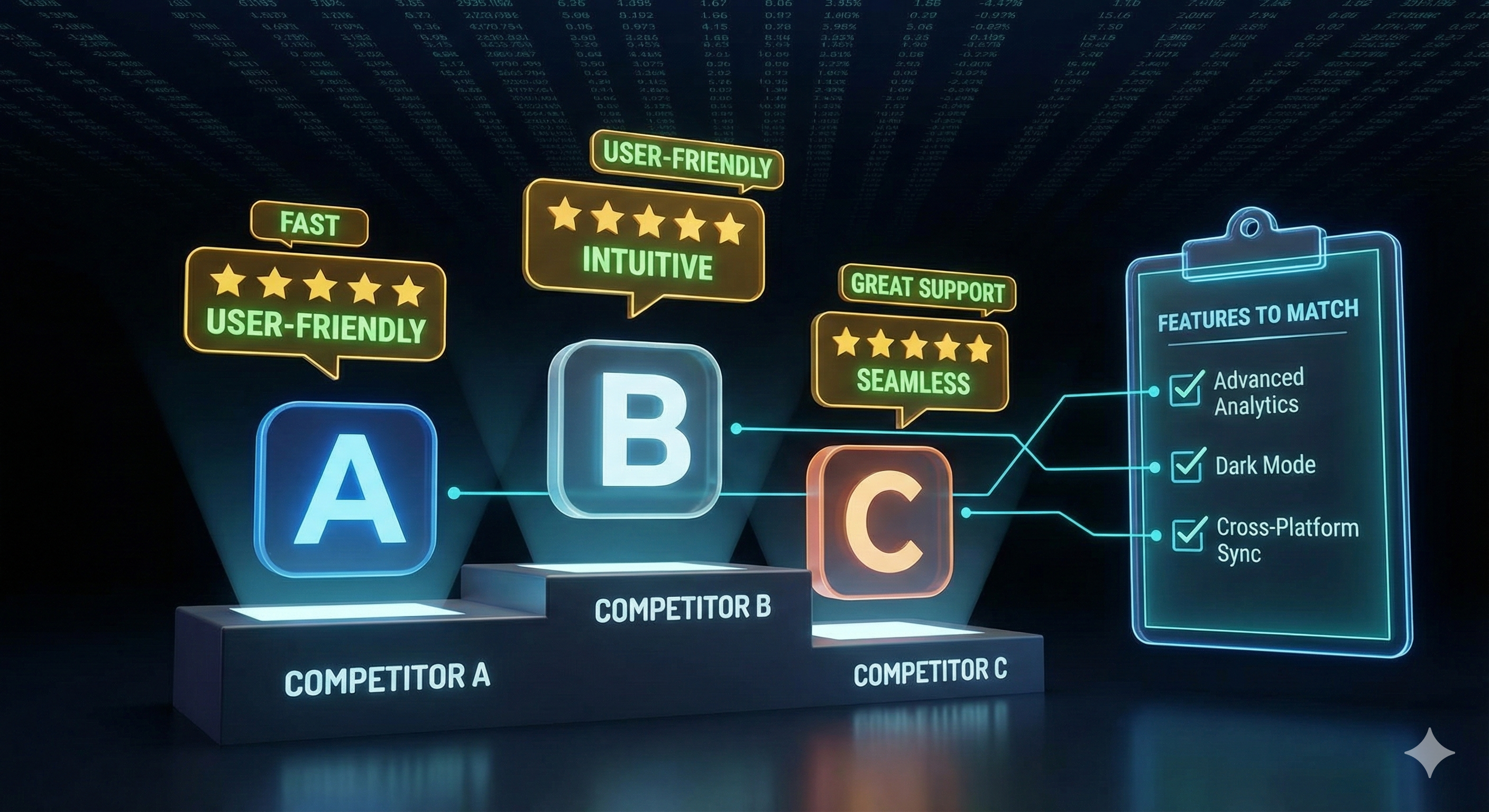
Don't just study failures. Understanding why users love competitors helps you identify table-stakes features and differentiation opportunities.
What Earns 5-Star Reviews?
Analyze top competitors' positive reviews to understand:
- Which features get mentioned most? These are must-haves for the category.
- What emotional language do users employ? This reveals what creates loyalty.
- What surprises and delights them? These are differentiation opportunities.
Example Analysis Framework
| Competitor | Most Praised Feature | Emotional Keywords | Insight |
|---|---|---|---|
| Competitor A | Simplicity | "intuitive," "clean," "just works" | Users value simplicity over features |
| Competitor B | Support | "responsive," "actually helped," "real person" | Human support is a differentiator |
| Competitor C | Integrations | "works with everything," "connected my workflow" | Ecosystem connectivity matters |
Turning Insights into Action
Action 1: Feature Prioritization
Use competitor review analysis to inform your roadmap:
High priority (build now):
- Features competitors have that their users love (table stakes)
- Features competitors lack that users are begging for (differentiation)
Medium priority (consider):
- Features with mixed reviews at competitors (do it better)
- Features users mention wanting but less frequently
Low priority (skip or delay):
- Features that rarely appear in reviews (low demand)
- Features competitors have that no one mentions (invisible)
Action 2: Positioning and Messaging
Craft messaging that speaks to competitor pain points:
If competitors have reliability issues:
"Built for reliability. Your data syncs flawlessly, every time."
If competitors have complex interfaces:
"Powerful doesn't have to mean complicated. Get started in seconds."
If competitors have poor support:
"Real humans, real help. Average response time: 2 hours."
Action 3: Strategic App Store Optimization
Use competitor keyword analysis:
- Identify keywords users use to describe what they want
- Note language patterns in competitor complaints
- Target terms like "[Competitor] alternative" if appropriate
Action 4: Targeted User Acquisition
Some users explicitly mention looking for alternatives. Consider:
- Content marketing addressing competitor pain points
- Comparison landing pages (done tastefully)
- Migration guides for users switching from competitors
Competitive Monitoring System
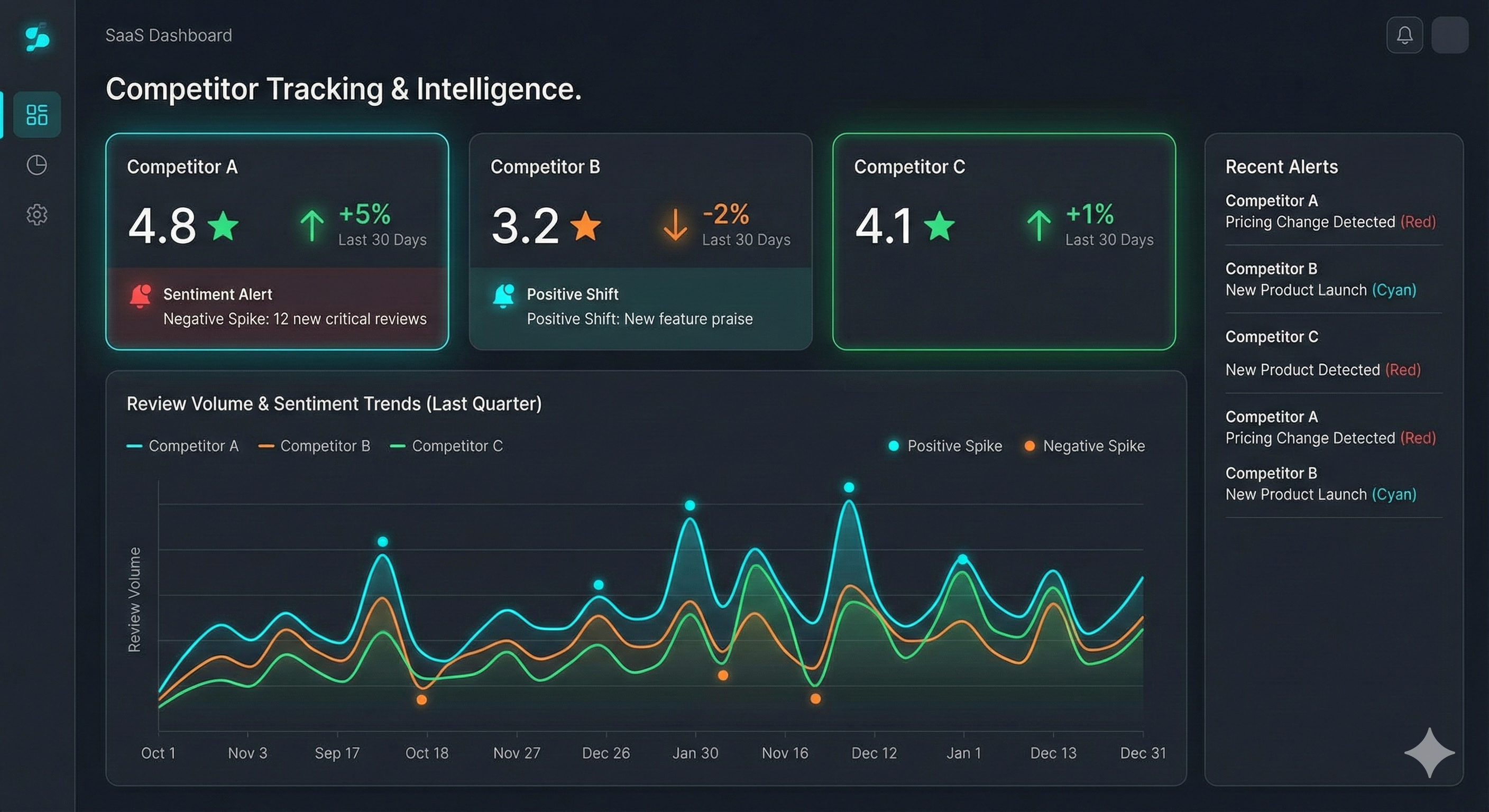
One-time analysis isn't enough. Set up ongoing monitoring:
Weekly Tasks
- Scan new 1-star reviews from top 3 competitors
- Note any new complaint patterns
- Check for major updates that triggered review changes
Monthly Tasks
- Analyze rating trends for all tracked competitors
- Update feature request frequency counts
- Review any changes in competitive positioning
Quarterly Tasks
- Full competitive review analysis refresh
- Update competitive positioning strategy
- Share insights with product and marketing teams
Case Study: Finding Opportunity in Competitor Pain
Let's walk through a hypothetical example:
Scenario: Habit Tracking App Market
Competitor Analysis Findings:
Competitor A (Market Leader, 4.6 stars):
- Praised for: Beautiful design, widgets
- Criticized for: Expensive subscription ($8/month), limited free tier
- Common request: One-time purchase option
Competitor B (4.2 stars):
- Praised for: Feature-rich, flexible
- Criticized for: Overwhelming complexity, steep learning curve
- Common request: Simpler onboarding
Competitor C (4.4 stars):
- Praised for: Free, simple
- Criticized for: No sync across devices, looks outdated
- Common request: Cloud sync, modern design
Strategic Opportunities Identified:
- Pricing gap: No player offers a mid-tier price with good value. Position at $3.99/month with generous free tier.
- Simplicity + beauty gap: No app is both simple AND beautiful. Competitor A is beautiful but complex pricing. Competitor C is simple but ugly.
- Sync + affordability gap: Users want sync but don't want to pay premium prices for it.
Resulting Positioning:
"Beautiful habit tracking that syncs everywhere. Simple pricing, powerful results. Free forever with optional $3.99/month Pro."
Ethics and Best Practices
Do:
- Learn from public information—reviews are meant to be read
- Focus on user needs—the goal is serving users better
- Compete on merit—build better products, not just better marketing
- Be honest in comparisons—if you make claims, back them up
Don't:
- Leave fake reviews on competitor apps (unethical and often illegal)
- Make false claims about competitors
- Obsess over competitors at the expense of your own vision
- Copy blindly—understand WHY something works
Key Takeaways
- Competitor reviews are free market research—users publicly share what's missing
- Analyze both negative and positive reviews—weaknesses show opportunities, strengths show table stakes
- Look for patterns, not individual complaints—recurring issues indicate systemic opportunities
- Turn insights into positioning—differentiate based on competitor weaknesses
- Monitor continuously—competitive landscapes change constantly
- Act ethically—compete on merit, not manipulation
Automate Your Competitive Analysis
Riviso's competitor analysis feature tracks your competitors' reviews automatically. Get alerts when sentiment shifts, identify emerging complaints, and spot opportunities before your competition does.
Start Competitor Tracking Free